<?xml version="1.0" encoding="utf-8"?><feed xmlns="http://www.w3.org/2005/Atom" xml:lang="en-US"><generator uri="https://jekyllrb.com/" version="4.1.1">Jekyll</generator><link href="https://advisory-akbar.kustirama.id//feed.xml" rel="self" type="application/atom+xml" /><link href="https://advisory-akbar.kustirama.id//" rel="alternate" type="text/html" hreflang="en-US" /><updated>2026-01-26T00:12:27+07:00</updated><id>https://advisory-akbar.kustirama.id//feed.xml</id><title type="html">advisory.abay.sh</title><subtitle>Where I pretend to know things and spot for my brain dumps.</subtitle><author><name>abay</name><email>akbar@kustirama.id</email></author><entry><title type="html">CVE-2024-37389 — Apache NiFi Improper Neutralization of Input in Parameter Context Description</title><link href="https://advisory-akbar.kustirama.id//cve-2024-37389/" rel="alternate" type="text/html" title="CVE-2024-37389 — Apache NiFi Improper Neutralization of Input in Parameter Context Description" /><published>2024-06-07T00:00:00+07:00</published><updated>2024-06-07T00:00:00+07:00</updated><id>https://advisory-akbar.kustirama.id//cve-2024-37389</id><content type="html" xml:base="https://advisory-akbar.kustirama.id//cve-2024-37389/"><![CDATA[<p>Apache NiFi 1.10.0 through 1.26.0 and 2.0.0-M1 through 2.0.0-M3 support a description field in the Parameter Context configuration that is vulnerable to cross-site scripting. An authenticated user, authorized to configure a Parameter Context, can enter arbitrary JavaScript code, which the client browser will execute within the session context of the authenticated user. Upgrading to Apache NiFi 1.27.0 or 2.0.0-M4 is the recommended mitigation.</p>

<p>This issue is being tracked as <a href="https://issues.apache.org/jira/browse/NIFI-13374" target="_blank" title="NIFI-13374">NIFI-13374</a></p>

<h3 id="proof-of-concepts">Proof of Concepts</h3>
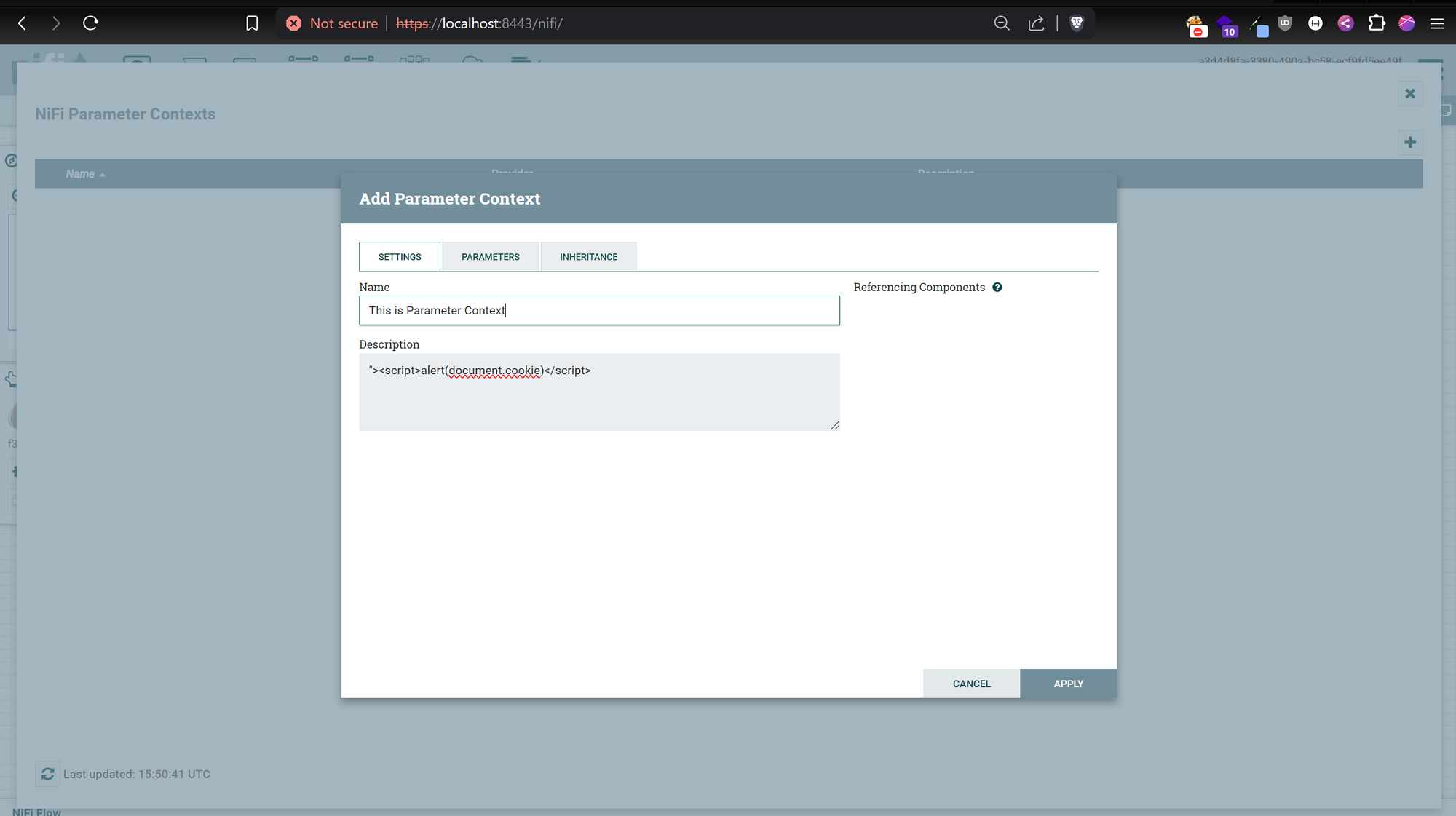
<p>Apache NiFi allows users to add comments to a Parameter Context. However, the input for this comments was not properly sanitized, leading to a Cross-Site Scripting (XSS) vulnerability. This could allow malicious users to inject and execute arbitrary scripts, posing significant security risks.</p>

<ol>
  <li>Create a new Parameter Context with XSS payload in the comment section.
<img src="https://files.abay.sh/abay.sh/apache-nifi-xss/apache-nifi-xss-1.png" title="apache-nifi-xss-1" /></li>
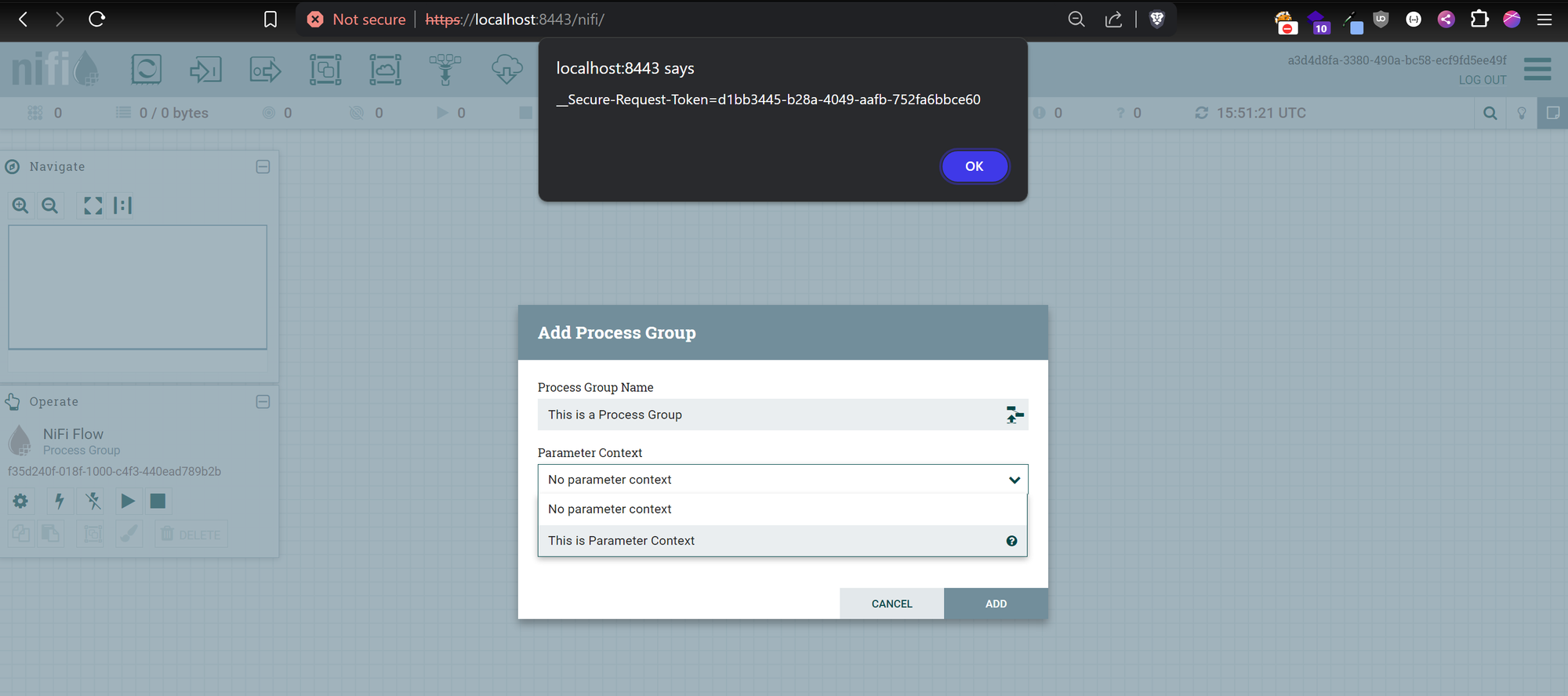
  <li>Create a new Process Group. While the popup shows, hover the cursor to the “?” icon to trigger XSS.
<img src="https://files.abay.sh/abay.sh/apache-nifi-xss/apache-nifi-xss-2.png" title="apache-nifi-xss-2" /></li>
</ol>

<p>XSS Payload will triggered once you hover in the <code class="language-plaintext highlighter-rouge">?</code> icon for description in tooltip.</p>

<h3 id="impact">Impact</h3>
<p>An authenticated user, authorized to configure a Parameter Context, can enter arbitrary JavaScript code, which the client browser will execute within the session context of the authenticated user.</p>

<h3 id="links">Links</h3>
<ul>
  <li><a href="https://issues.apache.org/jira/browse/NIFI-13374" title="issues.apache.org" target="_blank">[NIFI-13374] Fix tooltip for Parameter Context in new Process Group dialog - ASF JIRA</a></li>
  <li><a href="https://www.cve.org/CVERecord?id=CVE-2024-37389" target="_blank" title="cve.org">CVE-2024-37389 Detail - CVE.ORG</a></li>
  <li><a href="https://nifi.apache.org/documentation/security/#CVE-2024-37389" target="_blank" title="nifi.apache.org">Apache NiFi Published Vulnerabilities</a></li>
</ul>]]></content><author><name>abay</name><email>akbar@kustirama.id</email></author><category term="apache" /><category term="xss" /><summary type="html"><![CDATA[Apache NiFi 1.10.0 through 1.26.0 and 2.0.0-M1 through 2.0.0-M3 support a description field in the Parameter Context configuration that is vulnerable to cross-site scripting. An authenticated user, authorized to configure a Parameter Context, can enter arbitrary JavaScript code, which the client browser will execute within the session context of the authenticated user. Upgrading to Apache NiFi 1.27.0 or 2.0.0-M4 is the recommended mitigation.]]></summary></entry><entry><title type="html">CVE-2023-6487 — LuckyWP Table of Contents &amp;lt;= 2.1.4 - Authenticated Cross-Site Scripting</title><link href="https://advisory-akbar.kustirama.id//cve-2023-6487/" rel="alternate" type="text/html" title="CVE-2023-6487 — LuckyWP Table of Contents &amp;lt;= 2.1.4 - Authenticated Cross-Site Scripting" /><published>2024-05-21T00:00:00+07:00</published><updated>2024-05-21T00:00:00+07:00</updated><id>https://advisory-akbar.kustirama.id//cve-2023-6487</id><content type="html" xml:base="https://advisory-akbar.kustirama.id//cve-2023-6487/"><![CDATA[<p>The LuckyWP Table of Contents plugin for WordPress is vulnerable to Stored Cross-Site Scripting via the ‘Header Title’ field in all versions up to and including 2.1.4 due to insufficient input sanitization and output escaping. This makes it possible for authenticated attackers, with administrator-level access, to inject arbitrary web scripts in pages that will execute whenever a user accesses an injected page. This only affects multi-site installations and installations where unfiltered_html has been disabled.</p>

<h3 id="proof-of-concepts">Proof of Concepts</h3>
<p>The plugin provides features for custom Header Titles. The form was not sanitized, causing an XSS vulnerability</p>

<ol>
  <li>Open Table of Contents Settings
<code class="language-plaintext highlighter-rouge">/wp-admin/options-general.php?page=lwptoc_settings&amp;tab=general</code></li>
  <li>Add the XSS payload to the Header Title <code class="language-plaintext highlighter-rouge">Contents&lt;img src onerror=alert(/XSS/)&gt;</code></li>
</ol>

<p>The XSS payload will be triggered when a page with a Table of Contents is opened</p>

<h3 id="impact">Impact</h3>
<p>This makes it possible for authenticated attackers, to inject arbitrary web scripts in pages that will execute whenever a user accesses an injected page.</p>

<h3 id="links">Links</h3>
<ul>
  <li><a href="https://www.wordfence.com/threat-intel/vulnerabilities/wordpress-plugins/luckywp-table-of-contents/luckywp-table-of-contents-214-authenticatedadministrator-cross-site-scripting" title="Wordfence" target="_blank">LuckyWP Table of Contents &lt;= 2.1.4 - Authenticated Cross-Site Scripting</a></li>
  <li><a href="https://nvd.nist.gov/vuln/detail/CVE-2023-6487" title="nist.gov" target="_blank">CVE-2023-6487 - NIST.GOV</a></li>
</ul>]]></content><author><name>abay</name><email>akbar@kustirama.id</email></author><category term="wordpress" /><category term="xss" /><summary type="html"><![CDATA[The LuckyWP Table of Contents plugin for WordPress is vulnerable to Stored Cross-Site Scripting via the ‘Header Title’ field in all versions up to and including 2.1.4 due to insufficient input sanitization and output escaping. This makes it possible for authenticated attackers, with administrator-level access, to inject arbitrary web scripts in pages that will execute whenever a user accesses an injected page. This only affects multi-site installations and installations where unfiltered_html has been disabled.]]></summary></entry><entry><title type="html">CVE-2024-0598 — Gutenberg Blocks by Kadence Blocks &amp;lt;= 3.2.17 Editor+ Stored Cross-Site Scritpting via Slider Callback</title><link href="https://advisory-akbar.kustirama.id//cve-2024-0598/" rel="alternate" type="text/html" title="CVE-2024-0598 — Gutenberg Blocks by Kadence Blocks &amp;lt;= 3.2.17 Editor+ Stored Cross-Site Scritpting via Slider Callback" /><published>2024-04-09T00:00:00+07:00</published><updated>2024-04-09T00:00:00+07:00</updated><id>https://advisory-akbar.kustirama.id//cve-2024-0598</id><content type="html" xml:base="https://advisory-akbar.kustirama.id//cve-2024-0598/"><![CDATA[<p>The Gutenberg Blocks by Kadence Blocks – Page Builder Features plugin for WordPress is vulnerable to Stored Cross-Site Scripting via the contact form message settings in all versions up to and including 3.2.17 due to insufficient input sanitization and output escaping. This makes it possible for authenticated attackers, with editor-level access and above, to inject arbitrary web scripts in pages that will execute whenever a user accesses an injected page. This primarily affects multi-site installations and installations where unfiltered_html has been disabled.</p>

<p>The plugin provides a feature to customize “Message Settings” that means alert message that shown after form is submitted. These input is not sanitized, causing an XSS vulnerability.</p>

<h3 id="proof-of-concepts">Proof of Concepts</h3>
<ol>
  <li>Create New Post</li>
  <li>Add “Form (Adv)” block then Create New form</li>
  <li>Select “Contact” form and so on until the form is shown in your page</li>
  <li>On your sidebar, there’s Message Settings which a setting for message after form being submitted.</li>
  <li>Put XSS payload on “Success Message”
<code class="language-plaintext highlighter-rouge">&lt;img src onerror=alert(/XSS/)&gt;</code></li>
</ol>

<p>Open the created post and fill the form. XSS Payload will triggered after you submit the form.</p>

<h3 id="impact">Impact</h3>
<p>This makes it possible for authenticated attackers, with Editor-level permissions and above, to inject arbitrary web scripts in pages that will execute whenever a user accesses an injected page.</p>

<h3 id="links">Links</h3>
<ul>
  <li><a href="https://www.wordfence.com/threat-intel/vulnerabilities/wordpress-plugins/kadence-blocks/gutenberg-blocks-by-kadence-blocks-3217-authenticatededitor-stored-cross-site-scripting-via-contact-form-message-settings" title="Wordfence" target="_blank">Gutenberg Blocks by Kadence Blocks &lt;= 3.2.17 - Authenticated(Editor+) Stored Cross-Site Scripting via Contact Form Message Settings - Wordfence</a></li>
  <li><a href="https://nvd.nist.gov/vuln/detail/CVE-2024-0598" title="nist.gov" target="_blank">CVE-2024-0598 Detail - NIST.GOV</a></li>
</ul>]]></content><author><name>abay</name><email>akbar@kustirama.id</email></author><category term="wordpress" /><category term="xss" /><summary type="html"><![CDATA[The Gutenberg Blocks by Kadence Blocks – Page Builder Features plugin for WordPress is vulnerable to Stored Cross-Site Scripting via the contact form message settings in all versions up to and including 3.2.17 due to insufficient input sanitization and output escaping. This makes it possible for authenticated attackers, with editor-level access and above, to inject arbitrary web scripts in pages that will execute whenever a user accesses an injected page. This primarily affects multi-site installations and installations where unfiltered_html has been disabled.]]></summary></entry><entry><title type="html">CVE-2023-6486 — Spectra – WordPress Gutenberg Blocks &amp;lt;= 2.10.3 Contributor+ Stored Cross-Site Scritpting via Slider Callback</title><link href="https://advisory-akbar.kustirama.id//cve-2023-6486/" rel="alternate" type="text/html" title="CVE-2023-6486 — Spectra – WordPress Gutenberg Blocks &amp;lt;= 2.10.3 Contributor+ Stored Cross-Site Scritpting via Slider Callback" /><published>2024-04-03T00:00:00+07:00</published><updated>2024-04-03T00:00:00+07:00</updated><id>https://advisory-akbar.kustirama.id//cve-2023-6486</id><content type="html" xml:base="https://advisory-akbar.kustirama.id//cve-2023-6486/"><![CDATA[<p>The Spectra – WordPress Gutenberg Blocks plugin for WordPress is vulnerable to Stored Cross-Site Scripting via the Custom CSS metabox in all versions up to and including 2.10.3 due to insufficient input sanitization and output escaping. This makes it possible for authenticated attackers, with contributor-level access and above, to inject arbitrary web scripts in pages that will execute whenever a user accesses an injected page.</p>

<p>The plugin provides a Custom CSS option via Spectra Page Settings when creating a new post. However CSS input is not properly sanitized which can lead to XSS vulnerabilities.</p>

<h3 id="proof-of-concepts">Proof of Concepts</h3>
<ol>
  <li>Create a new post via <code class="language-plaintext highlighter-rouge">/wp-admin/post-new.php</code></li>
  <li>Click the Three Dots at the top right of your screen then select Spectra Page Settings.</li>
  <li>Enter the payload <code class="language-plaintext highlighter-rouge">&lt;/style&gt;&lt;script&gt;alert('Spectra XSS')&lt;/script&gt;&lt;style&gt;</code> in the Custom CSS column</li>
  <li>Fill in the post title and body content with whatever value you want</li>
</ol>

<p>The XSS payload will be triggered when anyone (including the admin) opens the post entry created.</p>

<h3 id="impact">Impact</h3>
<p>This makes it possible for authenticated attackers, with Contributor-level permissions and above, to inject arbitrary web scripts in pages that will execute whenever a user accesses an injected page.</p>

<h3 id="links">Links</h3>
<ul>
  <li><a href="https://www.wordfence.com/threat-intel/vulnerabilities/wordpress-plugins/ultimate-addons-for-gutenberg/spectra-wordpress-gutenberg-blocks-2103-authenticatedcontributor-cross-site-scripting-via-custom-css" title="Wordfence" target="_blank">Spectra – WordPress Gutenberg Blocks &lt;= 2.10.3 - Authenticated(Contributor+) Cross-Site Scripting via Custom CSS - Wordfence</a></li>
  <li><a href="https://nvd.nist.gov/vuln/detail/CVE-2023-6486" title="nist.gov" target="_blank">CVE-2023-6486 Detail - NIST.GOV</a></li>
</ul>]]></content><author><name>abay</name><email>akbar@kustirama.id</email></author><category term="wordpress" /><category term="xss" /><summary type="html"><![CDATA[The Spectra – WordPress Gutenberg Blocks plugin for WordPress is vulnerable to Stored Cross-Site Scripting via the Custom CSS metabox in all versions up to and including 2.10.3 due to insufficient input sanitization and output escaping. This makes it possible for authenticated attackers, with contributor-level access and above, to inject arbitrary web scripts in pages that will execute whenever a user accesses an injected page.]]></summary></entry><entry><title type="html">CVE-2023-4839 — WP Go Maps &amp;lt;= 9.0.32 Administrator+ Stored Cross-Site Scritpting via Slider Callback</title><link href="https://advisory-akbar.kustirama.id//cve-2023-4839/" rel="alternate" type="text/html" title="CVE-2023-4839 — WP Go Maps &amp;lt;= 9.0.32 Administrator+ Stored Cross-Site Scritpting via Slider Callback" /><published>2024-03-12T00:00:00+07:00</published><updated>2024-03-12T00:00:00+07:00</updated><id>https://advisory-akbar.kustirama.id//cve-2023-4839</id><content type="html" xml:base="https://advisory-akbar.kustirama.id//cve-2023-4839/"><![CDATA[<p>The WP Go Maps for WordPress is vulnerable to Stored Cross-Site Scripting via admin settings in versions up to, and including, 9.0.32 due to insufficient input sanitization and output escaping. This makes it possible for authenticated attackers, with administrator-level permissions and above, to inject arbitrary web scripts in pages that will execute whenever a user accesses an injected page. This only affects multi-site installations and installations where unfiltered_html has been disabled.</p>

<h3 id="proof-of-concepts">Proof of Concepts</h3>
<ol>
  <li>Go to the plugin page (/wp-admin/admin.php?page=master-slider) then create a new slider.</li>
  <li>Open the Slider that you have created then go to the Slider Callbacks tab</li>
  <li>Click “Add new callback” with any conditions (ex: On Youtube/Vimeo video close), then enter the XSS payload.
    <div class="language-javascript highlighter-rouge"><div class="highlight"><pre class="highlight"><code><span class="kd">function</span><span class="p">(</span><span class="nx">event</span><span class="p">){</span>
 <span class="kd">var</span> <span class="nx">api</span> <span class="o">=</span> <span class="nx">event</span><span class="p">.</span><span class="nx">target</span><span class="p">;</span>
 <span class="o">&lt;</span><span class="sr">/script&gt;&lt;img src onerror=alert</span><span class="se">(</span><span class="sr">/</span><span class="nx">XSS</span><span class="o">/</span><span class="p">)</span><span class="o">&gt;</span>
<span class="p">}</span>
</code></pre></div>    </div>
  </li>
  <li>Create a new Post using the shortcode for the slider that has been created</li>
</ol>

<p>If we directly use <code class="language-plaintext highlighter-rouge">alert(\xss\)</code>, the XSS payload will not be triggered because it does not meet the required conditions. However, we bypass this condition using the closing script (<code class="language-plaintext highlighter-rouge">&lt;/script&gt;</code>).</p>

<h3 id="impact">Impact</h3>
<p>This makes it possible for authenticated attackers, with Administrator-level permissions and above, to inject arbitrary web scripts in pages that will execute whenever a user accesses an injected page.</p>

<h3 id="links">Links</h3>
<ul>
  <li><a href="https://www.wordfence.com/threat-intel/vulnerabilities/wordpress-plugins/wp-google-maps/wp-go-maps-9032-authenticated-administrator-stored-cross-site-scripting" title="Wordfence" target="_blank">Master Slider – Responsive Touch Slider &lt; 3.9.5 - Authenticated(Editor+) Stored Cross-Site Scripting via slider callback - Wordfence</a></li>
  <li><a href="https://nvd.nist.gov/vuln/detail/CVE-2023-4839" title="nist.gov" target="_blank">CVE-2023-4839 Detail - NIST.GOV</a></li>
</ul>]]></content><author><name>abay</name><email>akbar@kustirama.id</email></author><category term="wordpress" /><category term="xss" /><summary type="html"><![CDATA[The WP Go Maps for WordPress is vulnerable to Stored Cross-Site Scripting via admin settings in versions up to, and including, 9.0.32 due to insufficient input sanitization and output escaping. This makes it possible for authenticated attackers, with administrator-level permissions and above, to inject arbitrary web scripts in pages that will execute whenever a user accesses an injected page. This only affects multi-site installations and installations where unfiltered_html has been disabled.]]></summary></entry><entry><title type="html">CVE-2024-0611 — Master Slider – Responsive Touch Slider &amp;lt; 3.9.5 Editor+ Stored Cross-Site Scritpting via Slider Callback</title><link href="https://advisory-akbar.kustirama.id//cve-2024-0611/" rel="alternate" type="text/html" title="CVE-2024-0611 — Master Slider – Responsive Touch Slider &amp;lt; 3.9.5 Editor+ Stored Cross-Site Scritpting via Slider Callback" /><published>2024-03-01T00:00:00+07:00</published><updated>2024-03-01T00:00:00+07:00</updated><id>https://advisory-akbar.kustirama.id//cve-2024-0611</id><content type="html" xml:base="https://advisory-akbar.kustirama.id//cve-2024-0611/"><![CDATA[<p>The Master Slider – Responsive Touch Slider plugin for WordPress is vulnerable to Stored Cross-Site Scripting via the slides callback functionality in all versions up to, and including, 3.9.5. This makes it possible for authenticated attackers, with editor-level access, to inject arbitrary web scripts in pages that will execute whenever a user accesses an injected page. This only affects multi-site installations and installations where unfiltered_html has been disabled.</p>

<p>This plugin provides a feature to customize Slider Callbacks via script (javascript). I know that the admin could just enter <code class="language-plaintext highlighter-rouge">alert(\\xss\\)</code> and this report would not be in scope. However, this plugin requires certain conditions that trigger this script, such as “On slider Init” or “On Youtube/Vimeo video close”.</p>

<h3 id="proof-of-concepts">Proof of Concepts</h3>
<ol>
  <li>Go to the plugin page (/wp-admin/admin.php?page=master-slider) then create a new slider.</li>
  <li>Open the Slider that you have created then go to the Slider Callbacks tab</li>
  <li>Click “Add new callback” with any conditions (ex: On Youtube/Vimeo video close), then enter the XSS payload.
    <div class="language-javascript highlighter-rouge"><div class="highlight"><pre class="highlight"><code><span class="kd">function</span><span class="p">(</span><span class="nx">event</span><span class="p">){</span>
 <span class="kd">var</span> <span class="nx">api</span> <span class="o">=</span> <span class="nx">event</span><span class="p">.</span><span class="nx">target</span><span class="p">;</span>
 <span class="o">&lt;</span><span class="sr">/script&gt;&lt;img src onerror=alert</span><span class="se">(</span><span class="sr">/</span><span class="nx">XSS</span><span class="o">/</span><span class="p">)</span><span class="o">&gt;</span>
<span class="p">}</span>
</code></pre></div>    </div>
  </li>
  <li>Create a new Post using the shortcode for the slider that has been created</li>
</ol>

<p>If we directly use <code class="language-plaintext highlighter-rouge">alert(\xss\)</code>, the XSS payload will not be triggered because it does not meet the required conditions. However, we bypass this condition using the closing script (<code class="language-plaintext highlighter-rouge">&lt;/script&gt;</code>).</p>

<h3 id="impact">Impact</h3>
<p>This makes it possible for authenticated attackers, with editor-level permissions and above, to inject arbitrary web scripts in pages that will execute whenever a user accesses an injected page.</p>

<h3 id="links">Links</h3>
<ul>
  <li><a href="https://www.wordfence.com/threat-intel/vulnerabilities/wordpress-plugins/master-slider/master-slider-responsive-touch-slider-395-authenticatededitor-stored-cross-site-scripting-via-slider-callback" title="Wordfence" target="_blank">Master Slider – Responsive Touch Slider &lt; 3.9.5 - Authenticated(Editor+) Stored Cross-Site Scripting via slider callback - Wordfence</a></li>
  <li><a href="https://nvd.nist.gov/vuln/detail/CVE-2024-0611" title="nist.gov" target="_blank">CVE-2024-0611 Detail - NIST.GOV</a></li>
</ul>]]></content><author><name>abay</name><email>akbar@kustirama.id</email></author><category term="wordpress" /><category term="xss" /><summary type="html"><![CDATA[The Master Slider – Responsive Touch Slider plugin for WordPress is vulnerable to Stored Cross-Site Scripting via the slides callback functionality in all versions up to, and including, 3.9.5. This makes it possible for authenticated attackers, with editor-level access, to inject arbitrary web scripts in pages that will execute whenever a user accesses an injected page. This only affects multi-site installations and installations where unfiltered_html has been disabled.]]></summary></entry><entry><title type="html">CVE-2024-0614 — Events Manager &amp;lt;= 6.4.6.4 Administrator+ Stored Cross-Site Scritpting via Settings</title><link href="https://advisory-akbar.kustirama.id//cve-2024-0614/" rel="alternate" type="text/html" title="CVE-2024-0614 — Events Manager &amp;lt;= 6.4.6.4 Administrator+ Stored Cross-Site Scritpting via Settings" /><published>2024-02-28T00:00:00+07:00</published><updated>2024-02-28T00:00:00+07:00</updated><id>https://advisory-akbar.kustirama.id//cve-2024-0614</id><content type="html" xml:base="https://advisory-akbar.kustirama.id//cve-2024-0614/"><![CDATA[<p>The Events Manager plugin for WordPress is vulnerable to Stored Cross-Site Scripting via admin settings in all versions up to, and including, 6.4.6.4 due to insufficient input sanitization and output escaping. This makes it possible for authenticated attackers, with administrator-level permissions and above, to inject arbitrary web scripts in pages that will execute whenever a user accesses an injected page. This only affects multi-site installations and installations where unfiltered_html has been disabled.</p>

<h3 id="proof-of-concepts">Proof of Concepts</h3>
<ol>
  <li>Go to plugin’s setting page
<code class="language-plaintext highlighter-rouge">/wp-admin/edit.php?post_type=event&amp;page=events-manager-options#general</code></li>
  <li>Under Privacy tab, input XSS Payload in Consent Text form
<code class="language-plaintext highlighter-rouge">&lt;img src onerror=alert(/XSS/)&gt;I consent to my submitted data being collected and stored as outlined by the site %s.</code></li>
  <li>Create new event and check “Enable registration for this event”</li>
</ol>

<p>XSS Payload will triggered on Event Page</p>

<h3 id="impact">Impact</h3>
<p>This makes it possible for authenticated attackers, with contributor-level permissions and above, to inject arbitrary web scripts in pages that will execute whenever a user accesses an injected page.</p>

<h3 id="links">Links</h3>
<ul>
  <li><a href="https://www.wordfence.com/threat-intel/vulnerabilities/wordpress-plugins/events-manager/events-manager-6464-authenticatedadministator-stored-cross-site-scripting-via-settings" title="Wordfence" target="_blank">Events Manager &lt;= 6.4.6.4 - Authenticated(Administator+) Stored Cross-Site Scripting via settings - Wordfence</a></li>
  <li><a href="https://nvd.nist.gov/vuln/detail/CVE-2024-0614" title="nist.gov" target="_blank">CVE-2024-0614 Detail - NIST.GOV</a></li>
</ul>]]></content><author><name>abay</name><email>akbar@kustirama.id</email></author><category term="wordpress" /><category term="xss" /><summary type="html"><![CDATA[The Events Manager plugin for WordPress is vulnerable to Stored Cross-Site Scripting via admin settings in all versions up to, and including, 6.4.6.4 due to insufficient input sanitization and output escaping. This makes it possible for authenticated attackers, with administrator-level permissions and above, to inject arbitrary web scripts in pages that will execute whenever a user accesses an injected page. This only affects multi-site installations and installations where unfiltered_html has been disabled.]]></summary></entry><entry><title type="html">CVE-2024-0602 — Yet Another Related Posts Plugin (YARPP) &amp;lt;= 5.30.9 - Authenticated(Administrator+) Stored Cross-Site Scripting via settings</title><link href="https://advisory-akbar.kustirama.id//cve-2024-0602/" rel="alternate" type="text/html" title="CVE-2024-0602 — Yet Another Related Posts Plugin (YARPP) &amp;lt;= 5.30.9 - Authenticated(Administrator+) Stored Cross-Site Scripting via settings" /><published>2024-02-20T00:00:00+07:00</published><updated>2024-02-20T00:00:00+07:00</updated><id>https://advisory-akbar.kustirama.id//cve-2024-0602</id><content type="html" xml:base="https://advisory-akbar.kustirama.id//cve-2024-0602/"><![CDATA[<p>The YARPP – Yet Another Related Posts Plugin plugin for WordPress is vulnerable to Stored Cross-Site Scripting via admin settings in all versions up to, and including, 5.30.9 due to insufficient input sanitization and output escaping. This makes it possible for authenticated attackers, with administrator-level permissions and above, to inject arbitrary web scripts in pages that will execute whenever a user accesses an injected page. This only affects multi-site installations and installations where unfiltered_html has been disabled.</p>

<p>The plugin provides a feature to customize wording for “excerpt”. These input is not sanitized, causing an XSS vulnerability.</p>

<h3 id="proof-of-concepts">Proof of Concepts</h3>
<ol>
  <li>Open YARPP Setting page
/wp-admin/options-general.php?page=yarpp</li>
  <li>Scroll to section “Automatic Discplay Options”</li>
  <li>Put XSS Payload in “Before / after (excerpt): “
` <small>&lt;img src onerror=alert(/XSS/)&gt;`</small></li>
</ol>

<h3 id="impact">Impact</h3>
<p>This makes it possible for authenticated attackers, with administrator-level permissions and above, to inject arbitrary web scripts in pages that will execute whenever a user accesses an injected page.</p>

<h3 id="links">Links</h3>
<ul>
  <li><a href="https://www.wordfence.com/threat-intel/vulnerabilities/wordpress-plugins/yet-another-related-posts-plugin/yet-another-related-posts-plugin-yarpp-5309-authenticatedadministrator-stored-cross-site-scripting-via-settings" title="Wordfence" target="_blank">Simple Share Buttons Adder &lt;= 8.4.11 - Authenticated(Administrator+) Stored Cross-Site Scripting via CSS Settings - Wordfence</a></li>
  <li><a href="https://www.cve.org/CVERecord?id=CVE-2024-0602" target="_blank" title="cve.org">CVE-2024-0602 Detail - CVE.ORG</a></li>
</ul>]]></content><author><name>abay</name><email>akbar@kustirama.id</email></author><category term="wordpress" /><category term="xss" /><summary type="html"><![CDATA[The YARPP – Yet Another Related Posts Plugin plugin for WordPress is vulnerable to Stored Cross-Site Scripting via admin settings in all versions up to, and including, 5.30.9 due to insufficient input sanitization and output escaping. This makes it possible for authenticated attackers, with administrator-level permissions and above, to inject arbitrary web scripts in pages that will execute whenever a user accesses an injected page. This only affects multi-site installations and installations where unfiltered_html has been disabled.]]></summary></entry><entry><title type="html">CVE-2024-0604 — Best WordPress Gallery Plugin – FooGallery &amp;lt;= 2.4.7 -Authenticated(Administrator+) Stored Cross-Site Scripting via settings</title><link href="https://advisory-akbar.kustirama.id//cve-2024-0604/" rel="alternate" type="text/html" title="CVE-2024-0604 — Best WordPress Gallery Plugin – FooGallery &amp;lt;= 2.4.7 -Authenticated(Administrator+) Stored Cross-Site Scripting via settings" /><published>2024-02-14T00:00:00+07:00</published><updated>2024-02-14T00:00:00+07:00</updated><id>https://advisory-akbar.kustirama.id//cve-2024-0604</id><content type="html" xml:base="https://advisory-akbar.kustirama.id//cve-2024-0604/"><![CDATA[<p>The Best WordPress Gallery Plugin – FooGallery plugin for WordPress is vulnerable to Stored Cross-Site Scripting via admin settings in all versions up to, and including, 2.4.7 due to insufficient input sanitization and output escaping. This makes it possible for authenticated attackers, with administrator-level permissions and above, to inject arbitrary web scripts in pages that will execute whenever a user accesses an injected page. This only affects multi-site installations and installations where unfiltered_html has been disabled.</p>

<h3 id="proof-of-concepts">Proof of Concepts</h3>
<ol>
  <li>Open plugin setting and go to Language section
/wp-admin/edit.php?post_type=foogallery&amp;page=foogallery-settings#language</li>
  <li>Put XSS Payload ‘Image Viewer “Prev” Text’ form
<code class="language-plaintext highlighter-rouge">Prev&lt;/script&gt;&lt;img src onerror=alert(/XSS/)&gt;</code></li>
  <li>Create new Gallery and put the shortcode in a new post</li>
</ol>

<p>XSS Payload will triggered in the created post.</p>

<p><code class="language-plaintext highlighter-rouge">var FooGallery_il8n = {"template":{"image-viewer":{"prev":"Prev&lt;/script&gt;&lt;img src onerror=alert(/XSS/)&gt;"}}};</code></p>

<p>Note: All form in <strong>**Image Viewer Template</strong>** is vulnerable to XSS</p>

<h3 id="impact">Impact</h3>
<p>This makes it possible for authenticated attackers, with administrator-level permissions and above, to inject arbitrary web scripts in pages that will execute whenever a user accesses an injected page.</p>

<h3 id="links">Links</h3>
<ul>
  <li><a href="https://www.wordfence.com/threat-intel/vulnerabilities/wordpress-plugins/foogallery/best-wordpress-gallery-plugin-foogallery-247-authenticatedadministrator-stored-cross-site-scripting-via-settings" title="Wordfence" target="_blank">Best WordPress Gallery Plugin – FooGallery &lt;= 2.4.7 -Authenticated(Administrator+) Stored Cross-Site Scripting via settings - Wordfence</a></li>
  <li><a href="https://www.cve.org/CVERecord?id=CVE-2024-0604" target="_blank" title="cve.org">CVE-2024-0604 Detail - CVE.ORG</a></li>
</ul>]]></content><author><name>abay</name><email>akbar@kustirama.id</email></author><category term="wordpress" /><category term="xss" /><summary type="html"><![CDATA[The Best WordPress Gallery Plugin – FooGallery plugin for WordPress is vulnerable to Stored Cross-Site Scripting via admin settings in all versions up to, and including, 2.4.7 due to insufficient input sanitization and output escaping. This makes it possible for authenticated attackers, with administrator-level permissions and above, to inject arbitrary web scripts in pages that will execute whenever a user accesses an injected page. This only affects multi-site installations and installations where unfiltered_html has been disabled.]]></summary></entry><entry><title type="html">CVE-2024-0621 — Simple Share Buttons Adder &amp;lt;= 8.4.11 - Authenticated(Administrator+) Stored Cross-Site Scripting via CSS Settings</title><link href="https://advisory-akbar.kustirama.id//cve-2024-0621/" rel="alternate" type="text/html" title="CVE-2024-0621 — Simple Share Buttons Adder &amp;lt;= 8.4.11 - Authenticated(Administrator+) Stored Cross-Site Scripting via CSS Settings" /><published>2024-02-14T00:00:00+07:00</published><updated>2024-02-14T00:00:00+07:00</updated><id>https://advisory-akbar.kustirama.id//cve-2024-0621</id><content type="html" xml:base="https://advisory-akbar.kustirama.id//cve-2024-0621/"><![CDATA[<p>The Simple Share Buttons Adder plugin for WordPress is vulnerable to Stored Cross-Site Scripting via admin settings in all versions up to, and including, 8.4.11 due to insufficient input sanitization and output escaping. This makes it possible for authenticated attackers, with administrator-level permissions and above, to inject arbitrary web scripts in pages that will execute whenever a user accesses an injected page. This only affects multi-site installations and installations where unfiltered_html has been disabled.</p>

<p>The plugin provides a feature to customize style, but we can escape the &lt;/style&gt;. These input is not sanitized, causing an XSS vulnerability.</p>

<h3 id="proof-of-concepts">Proof of Concepts</h3>
<ol>
  <li>Open plugin setting then go to “Advanced Setting” tab
/wp-admin/options-general.php?page=simple-share-buttons-adder</li>
  <li>Insert XSS Payload in “Custom CSS” form
<code class="language-plaintext highlighter-rouge">&lt;/style&gt;&lt;img src onerror=alert(/XSS/)&gt;</code></li>
  <li>Set where your share button location</li>
</ol>

<p>XSS Payload will triggered in the created post
.</p>
<h3 id="impact">Impact</h3>
<p>This makes it possible for authenticated attackers, with administrator-level permissions and above, to inject arbitrary web scripts in pages that will execute whenever a user accesses an injected page.</p>

<h3 id="links">Links</h3>
<ul>
  <li><a href="https://www.wordfence.com/threat-intel/vulnerabilities/wordpress-plugins/simple-share-buttons-adder/simple-share-buttons-adder-8411-authenticatedadministrator-stored-cross-site-scripting-via-css-settings" title="Wordfence" target="_blank">Simple Share Buttons Adder &lt;= 8.4.11 - Authenticated(Administrator+) Stored Cross-Site Scripting via CSS Settings - Wordfence</a></li>
  <li><a href="https://www.cve.org/CVERecord?id=CVE-2024-0621" target="_blank" title="cve.org">CVE-2024-0621 Detail - CVE.ORG</a></li>
</ul>]]></content><author><name>abay</name><email>akbar@kustirama.id</email></author><category term="wordpress" /><category term="xss" /><summary type="html"><![CDATA[The Simple Share Buttons Adder plugin for WordPress is vulnerable to Stored Cross-Site Scripting via admin settings in all versions up to, and including, 8.4.11 due to insufficient input sanitization and output escaping. This makes it possible for authenticated attackers, with administrator-level permissions and above, to inject arbitrary web scripts in pages that will execute whenever a user accesses an injected page. This only affects multi-site installations and installations where unfiltered_html has been disabled.]]></summary></entry></feed>